III. EUROPENSES

III. EUROPENSES | SYMBOL OF THE EUROPEANS
The Name of Europe
Europa derives from a variant of the Greek word eurōpē, with a transparent etymology: “wide-gazing,” an epithet that has equivalents in the poetic language of many European peoples. The meaning of this word is “she whose gaze reaches far.” In myth, Europa, abducted by Zeus, symbolizes universal power, particularly that of the nourishing and maternal Earth, while the god of the diurnal sky is her complement. Their union takes place beneath the tree that represents the axis of the world. 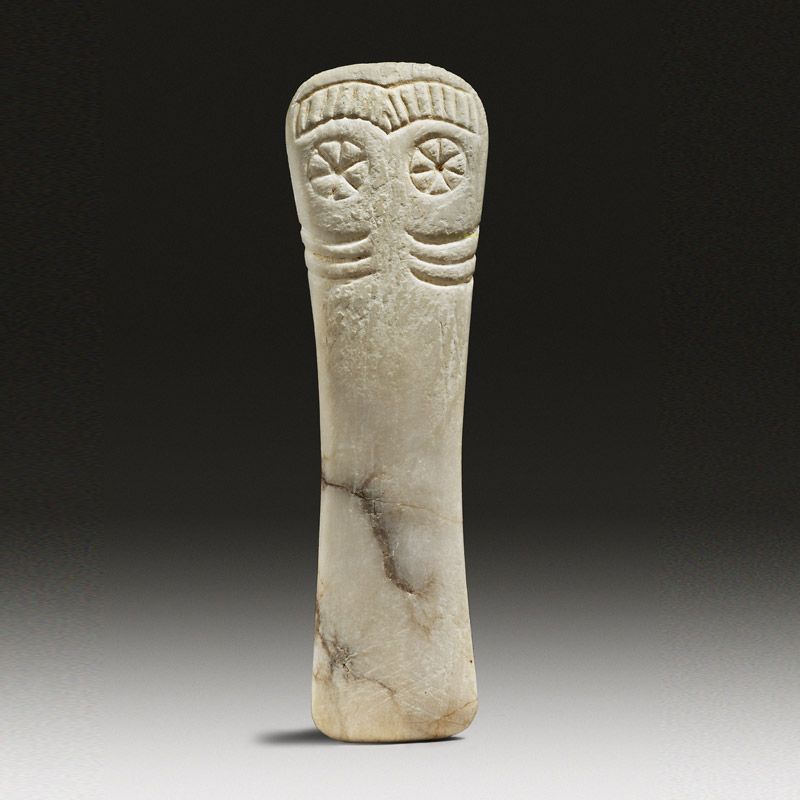 Europa’s far-reaching gaze echoes the large eyes of the Neolithic goddess,often represented on various supports (for example at Los Millares, as noted by J. Briard, L’Âge du Bronze en Europe, Paris, 1997, p. 16), and corresponds to the two celestial bodies, Sun and Moon, which embody the two halves—day and night, summer and winter—of natural cycles and serve as the two eyes of the universe.
The Representation of Europe
Based on this, an emblem is conceived that brings together the nine-branched tree, the Sun, and the Moon, as is customary in countless works of folk art.
In this context, it is worth noting that the geographer Kai-Helge Wirth, in agreement with a hypothesis by Isaac Newton, identified in the stellar coordinate system of the ancient zodiac a “celestial map” of ocean currents, developed in pre- and protohistoric times. Europe is defined there by the constellations of Ursa Major to the northeast, Heracles and Draco to the northwest, Corona and Scorpio to the west, and Leo and Virgo (with the Ear of Wheat) to the south (Ursprung des Sternbilder, ein prähistorisches Navigationssystem, no place, Sept. 2000).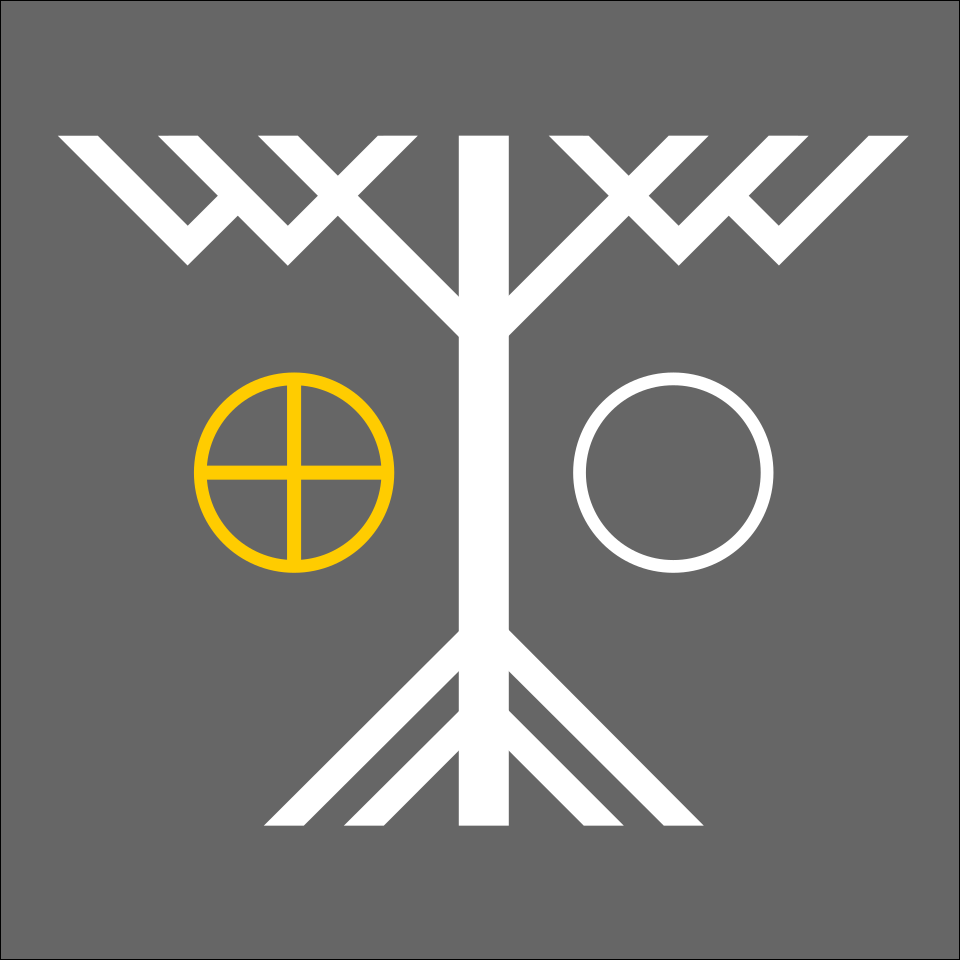 Several institutions adopted (in 1955 and 1986) a blue flag with twelve five-pointed stars arranged in a circle. This symbolism can satisfy most users and transcends the framework of political institutions to serve as a reference for the entire continent. The central void of this flag calls for a complement. What precedes offers a suggestion: Europe should adopt the cross or the tree, both frequent symbols in its cultures since the Upper Paleolithic and Mesolithic periods.
The Floral Emblem of Europeans
Many peoples have a flower or emblematic plant. For Europeans, Ph. Jouët has proposed the eight-petaled dryad, Dryas octopetala, a white rosaceous flower with a golden heart, known as mountain avens, chênette, Alpine tea, weiße Silberwurz, té dels Pireneos, derrig, leaithínn, rožu dzimta, lapinvuokko, etc. (already symbolically associated with two northern territories in Europe and North America). The name dryas refers to the oak nymphs of Greek mythology and also designates the climatic oscillations of the Late Glacial period—the Dryas. The eight-petaled dryas was the first flowering plant to recolonize regions freed from ice, thereby marking the end of the great winter, both real and mythical.