


Presentation
The Walloon Community within the Belgian state brings together the Picard, Champenois, Lorrain-Gaumois, and Walloon proper regions (of “linguistic Wallonia”) that identify with it. Within the French state, the country of Givet is Walloon. The ethnonym “Walloon” has also extended to certain Picard-speaking regions, in a broader sense meaning “Romance” or “Gallican.”
Descended from the Carolingian Empire, the provinces of Wallonia were almost all members of the Burgundian Netherlands, and later of the Seventeen Provinces (“the lands of this side”). Liège was an imperial principality.
Wallonia is separated by a very artificial frontier from its neighbors in Gallican Artois and southern Hainaut, which are linguistically Picard and likewise belonged to the Seventeen Provinces before the French royal annexations; they remained “in the manner of a foreign land in effect” until the Revolution in Paris.
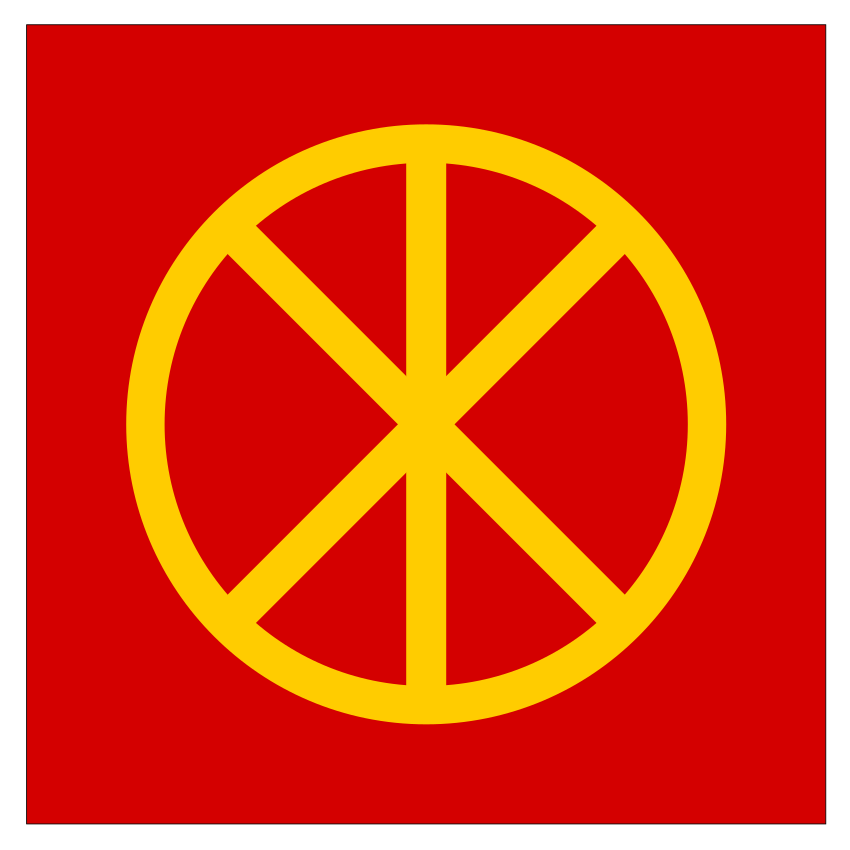
The Cross of Burgundy, formed of two crossed ragged staves, is associated with the history of these regions. This explains the raguly saltire seen on flags, coats of arms (Philippeville), coins (tokens of the Chambre des Comptes of Lille, 1545; “Thaler with the Cross” of the 17th century), and official documents.
The Belgian province of Luxembourg bears the red lion of the Grand Duchy.
A consensus emerged in the 19th century on the use of red and gold as Walloon colors — sometimes with the addition of white — for the earliest Walloon association flags. Among other proposals, the emblem of the “coq hardy” (the heraldic hardy rooster, ready for combat) gradually prevailed, first for the Walloon linguistic community, then for the administrative region of Wallonia (though it does not correspond closely to the heraldic symbolism of the Romance provinces, which widely employ the lion).
In popular tradition, the red rooster symbolizes the fire of awakening and vigilance.
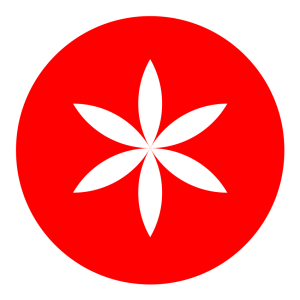
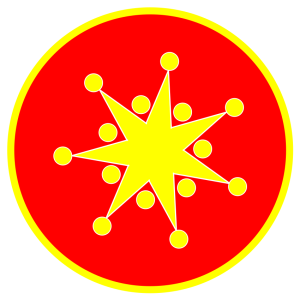
The Walloons also have as an emblem the Gaillardia flower (Gaillardia, an aster), in Walloon colors, easily stylized and confirmed as the “official floral emblem of the Walloon homeland” (Walloon Assembly, March 29, 1914, single article). It is this rallying sign that is represented here.
Suitable for all Romanic-speaking lands (the “Roman Netherlands”) derived mostly from the Seventeen Provinces, another possible emblem (in regional colors) may be noted: a bundle of six red arrows on a gold field bordered in blue, symbolizing Namur, Wavre, Romance Luxembourg, Hainaut (including its southern part within the French state), and Artois, to which Liège is added.
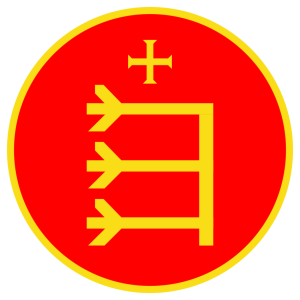
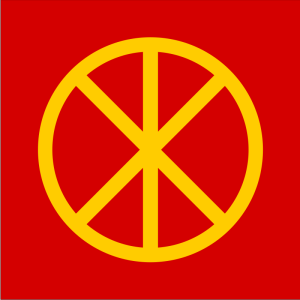
Another emblem that would suit this ensemble is the Merovingian and Carolingian crest (crista geminae), a cross adorned at its top with two circular arcs or twin crests, forming something like an inverted anchor. In local colors, this sign would be red on a gold background.
Merovingian crest
Location
-
Charleroi, Hainaut, Wallonia, 6000, Belgium


Add a comment