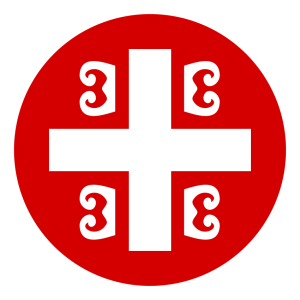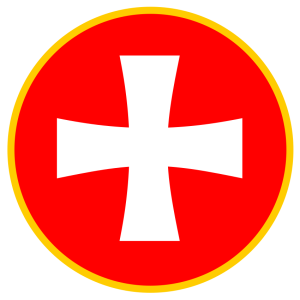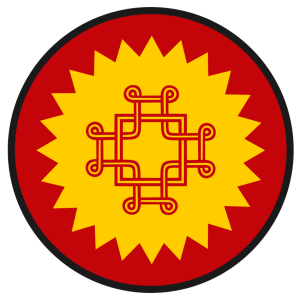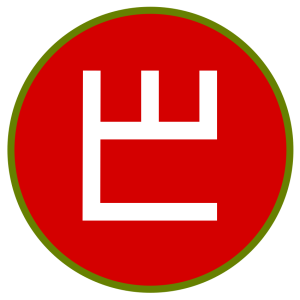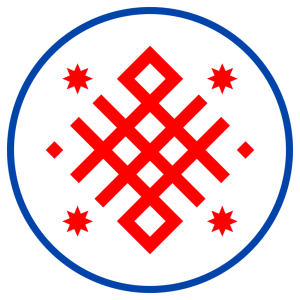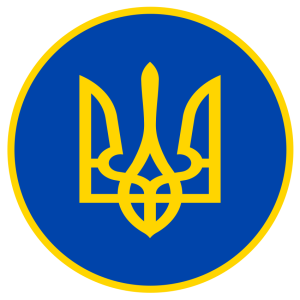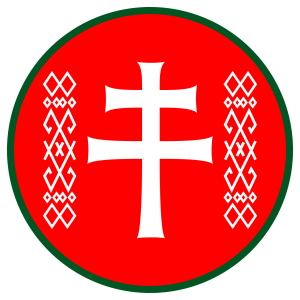
Description
The Slavic group (the ethnonym slav-, from *k̑lew- “to hear,” hence “those who speak (the same language)” or “the renowned ones”) initially developed around the 5th century BCE between the Carpathians and the Pripet Marshes. The vast North European Plain has seen the successive presence of Germanic, Baltic, and both Western and Eastern Slavic peoples, within shifting boundaries. The Eastern Slavic peoples resisted the pressures of the Huns (4th c.), the Avars, Obri, and Uyghurs (5th and 6th c.), the Pechenegs in the 9th and 10th centuries, the Cumans or Polovtsians, the Tatars in the 13th, and the Ottoman Turks. Today, alongside their Uralic neighbors, they constitute the main population group of Siberia.
Linguistically, the Slavs are divided into Western, Eastern, and Southern branches, which belong to distinct cultural spheres.
The Eastern Slavs were originally the Rusians, founders of the first Rus’, that of Kyiv, Latinized as Ruthenia, close to the site of Slavic ethnogenesis, and still honoring its pagan pantheon as late as 800 CE under the Grand Prince Vladimir the Fair Sun.
Ruthenia was devastated by the Mongol invasion in the 13th century and partly reemerged in the “Lithuanian Russia”, which, from the Niemen to the Black Sea, restored the ancient trade route “from the Varangians to the Greeks.”
From this arose local designations: White Rus’ (Vitebsk–Smolensk), Black Rus’ (Polesia), Red Rus’ (Galicia), and Green Rus’ (Bukovina), derived from the original ethnonym.
Muscovite Russia, emerging from the principality of Moscow, formed the eastern branch of the Eastern Slavs.
The ethno-cultural complex of the Balkans, where Slavs, Albanians, Romance peoples, and Hellenes coexist, is one of the cores of Old Europe. The “Southern Slavs”, who came from migrations beginning in the early 6th century CE, are one of the components of this Balkan whole, to which their Sklaveniai helped repopulate.
From ancient conceptions to images: in Slavic-speaking countries, monumental ritual pillars offered a vision of the world and of society. Their four sides bore depictions of ancient Indo-European protective deities (notably the monuments of Zbruch and Preslav). This quaternity provides the fundamental model for Slavic worldviews (cf. G. Dumézil, La courtisane et les seigneurs colorés, Paris, 1983, pp. 199–208).
This representation aligns perfectly with motifs in Slavic folk art (weaving, engraving, etc.), explored in particular by B. A. Rybakov, Jazyčestvo Drevnej Rusi (1987) and Jazyčestvo Drevnikh Slavjan (1981).
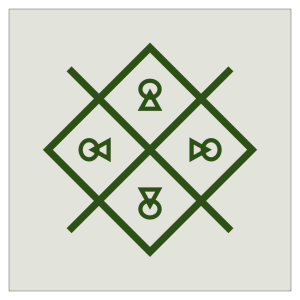
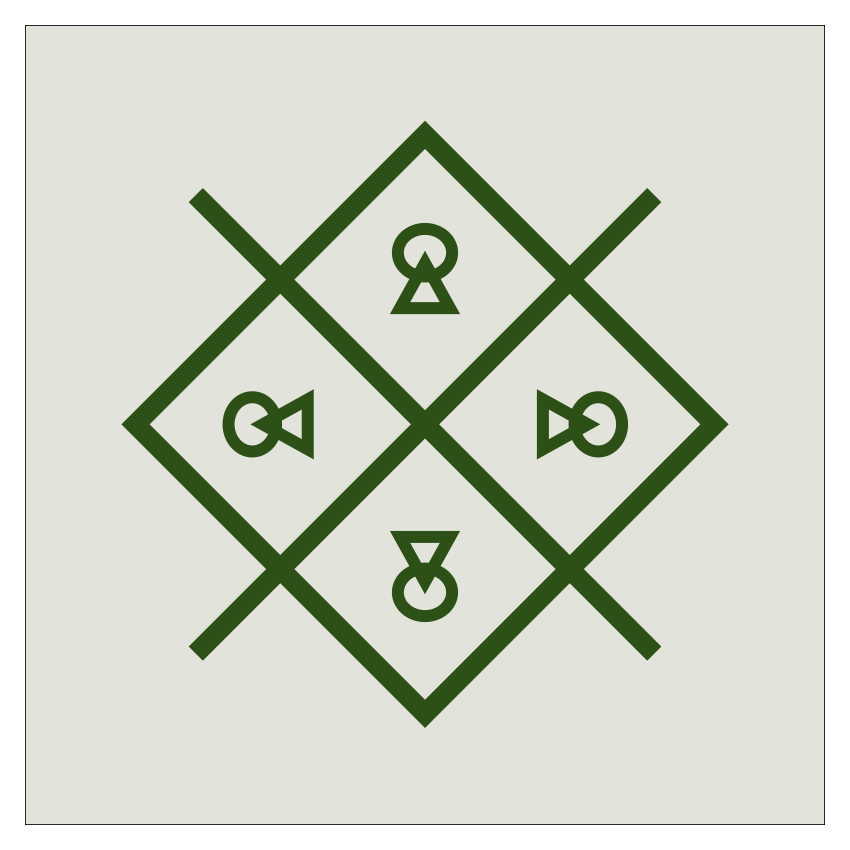
These traditional, coherent, and enduring elements yield the fourfold symbol reproduced here. It is interpreted as the sown and enclosed field, the domain—an image of the ancestral, organized territory protected by Mother Earth, invoked against the evil forces coming from the four directions of space.
The Glagolitic character S for slovo (a triangle topped with a circle) may represent the ethnonym by acronymy.
Thus, we use here the quadruple square and four Glagolitic S characters.
► Regarding the graphic symbolism of Slavic peoples, the use of Glagolitic characters is possible when needed.
Glagolitic (glagolitsa in Russian, hlagolica in Bulgarian, hlaholice in Czech, hlaholika in Slovak, glagolica in Polish, glagoljica in Serbo-Croatian, hlaholycia in Ukrainian, hlaholica in Belarusian) is the oldest Slavic alphabet (9th century), originating from a set of twenty-four signs later expanded for full use as a writing system.
(See: P. Cubberley, “The Slavic Alphabets,” in Daniels, Peter and Bright (eds.), The World’s Writing Systems, New York and Oxford, 1996.)
Ancient (sung) acronyms are associated with the Glagolitic letters (Az–buki…).