

Presentation
The arrival of the Slavs in the Balkans explains the origin of the modern Macedonians, linguistically close to the Bulgarians and the Serbs. Macedonia is the cradle of the first Glagolitic alphabet. The 19th and 20th centuries saw the emergence of a Macedonian political nationality. Although two centuries of upheavals have altered the distribution of the Balkan peoples, Greece still hosts along its northern borders a few thousand Slavophones, Macedonians and Bulgarians.
Macedonian patriots displayed the colors red and black in various forms, hence the red-and-black divided flag used in the 19th century and during the attempt at independence in 1903. After Macedonian independence, an initial “sun” flag based on an ancient Macedonian motif having been contested by the Greek state, a rising-sun design became official in the Republic of Macedonia (there are variants in which the rays are better proportioned relative to the field).
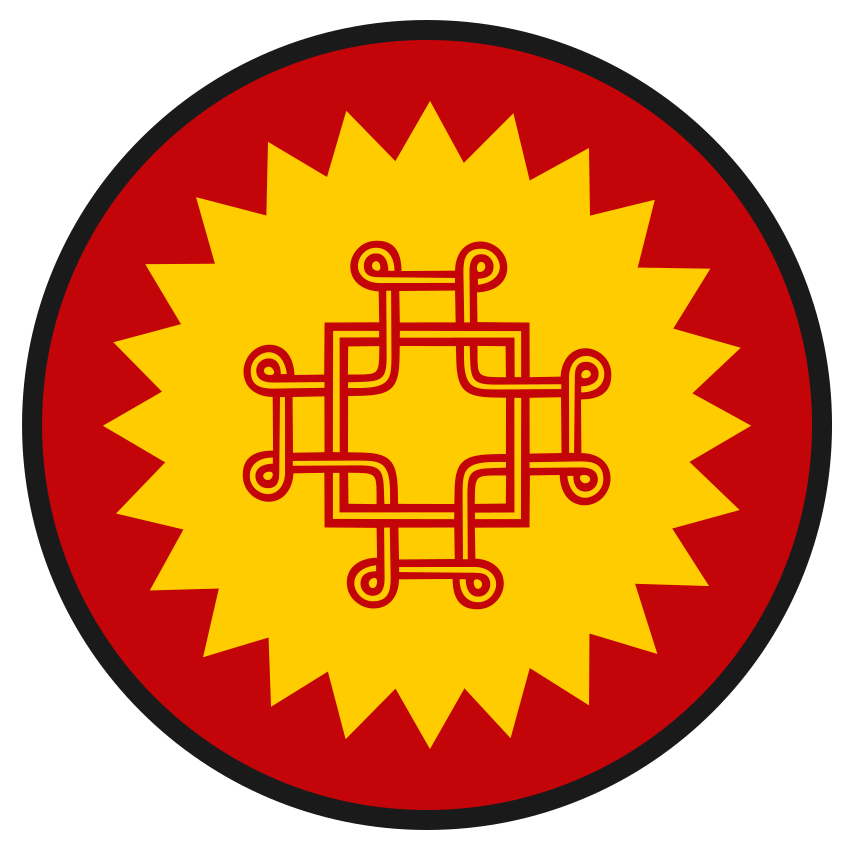
The national emblem of the Macedonians is a sun, the novo sonce na slobodata, “the new sun of freedom,” of the national anthem. There exists a specifically Macedonian sign, the makedonski krst, a millennia-old emblem of ethno-cultural identity that extends protohistoric, ancient, and medieval cruciform models. The center of the square represents the country, while the branches, which discreetly suggest a rotation, form a protective enclosure. The design follows the interlace technique so frequent in Balkan art. Here, the black and red colors come from historical patriotic flags.
Location
-
Kilkis, Kilkis Municipality, Kilkis Regional Unit, Central Macedonia, Macedonia and Thrace, 611 00, Greece


Add a comment