

Presentation
In the 1st century of our era, the Frisians were found between the Rhine and the Ems. Farmers and fishermen who, in the 2nd century, settled farther east and south as far as the Scheldt, they took part in the Saxon confederation. Frisian is intermediate between English and Low German (Ger. Kirche, Frs. tserke / Eng. church). Its current dispersion, like that of the name itself, bears witness to the ancient extension of the group. The fryske frijheid, "Frisian freedom", has remained proverbial: "Rather dead than enslaved", Lewer duad as slaw (North Frisian).
The West Frisians are the most numerous, Westfriezen, inhabitants of Fryslân in the Kingdom of the Netherlands. Their flag, recognized in 1897, reproduces the ancient arms bearing seven water-lily leaves (pompeblêdden), symbol of the country’s seven regions.
The East Frisians, Seelterfräisen, are found in Germany at Aurich and in the Saterland, Seelterlund, the linguistic domain of seeltersk (in Lower Saxony, Cloppenburg west of Bremen).
The North Frisians, Nuurdfresen, are a branch of the Frisians whose language (friisk, frasch) is spoken by roughly ten thousand people in the district of Nordfriesland (Südtondern, Husum, Eiderstedt, Sylt, Föhr, Amrum, the Halligen, Heligoland).
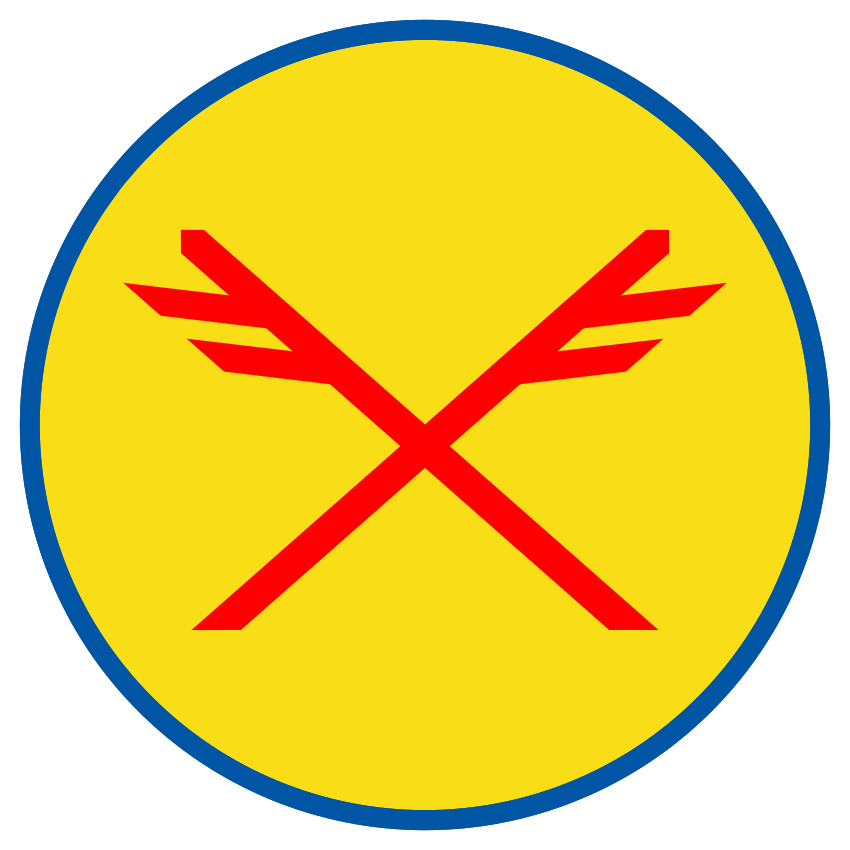
The Frisians are represented here by two F runes following the principle of acronymy. The crossing of these two signs recalls the assembly of ridge-beams, Giebelschmuck, well known in Frisian regions, representing the ‘divine twins’ who protect the house in the form of swans or horses (Rossgoschen).
Location
-
Aurich, Landkreis Aurich, Lower Saxony, Germany


Add a comment