

Presentation
The Germans are the T/Deutschen (Teutoni in Caesar, Gothic thiuda, Old High German deot “people,” hence diutisc “German,” but English Dutch “Netherlandish”); the French Allemands takes up the name of the federation of the Alamans, “All-the-Men” or “assembled people” (Gothic in allaim alamannam). The name of the Germans was originally an adjective meaning “who belongs to the people”; the modern sense appears in the time of Charlemagne.
The roughly one hundred million Europeans who share the German language in Europe—“the language of new thoughts and deep feelings” (Mme de Staël)—do not belong to a single state; thus the meaning of the term “German” is more or less broad depending on the situations considered. Some of the German communities of Central and Eastern Europe survived the eradications of the years 1918–1920, 1945, and thereafter: forty thousand Germans in northern Bohemia and Moravia; more than two hundred thousand in Hungary; some thirty thousand “Transylvanian Saxons” (Siebenbürgen) and “Banat Swabians” in Romania, a remnant of the Danube settlers who once came from Württemberg, Baden, and Lorraine (Rumäniendeutsche); small groups in Slovenia. In the Polish state there remain a few tens of thousands of declared Germans, scattered throughout the whole former empire as it existed before 1918 (in Pomerania, Silesia, the March of Brandenburg, East Prussia, and beyond), and about one hundred and fifty thousand in Upper Silesia (from Opole/Oppeln to Katowice and Racibórz/Ratibor). The Germans in Russia, who descend notably from the colonists of the eighteenth century, number about five hundred thousand.
German-speakers in Belgium are divided into two regions: territories included in Belgium at its creation (Montzen, Welkenraedt, Arlon/Arel), where two, even three languages coexist, and territories annexed in 1919 (Eupen, Kelmis/La Calamine, Saint-Vith, Malmédy). The northeast uses platdiets, the center Ripuarian Franconian, the south Moselle Franconian. German sentiment predominates in the communes annexed in the twentieth century. The Grand Duchy of Luxembourg influences the Belgian province of the same name.
The flag of the Federal Republic of Germany ultimately derives from the imperial banner. It takes up the heraldic colors of the Holy Roman Empire—those of the black eagle with red beak and talons on a gold field—which many tricolor flags displayed in various combinations. It was the Lützow Free Corps that ensured the success of the German tricolor in 1813, during the War of National Liberation, and the students who subsequently gave it its common appearance, officially recognized on 9 March 1848 by the federal assembly meeting in Frankfurt. In 1867 Chancellor Bismarck obtained the official adoption of the black, white, and red tricolor, the colors of the new Empire of 1871. From 1918 onward the black–red–gold flag again became official for the state. Modern Germany, which in this respect follows the former Federal Republic and German Democratic Republic, has returned to the colors black, red, and gold.
Given its origin, the black–red–gold flag could serve as an effective emblem for all German-language countries, heirs of the Holy Empire, but its reduction to state use does not go in this direction. In practice, this flag is used by the Germans of the eponymous state and by the German minorities of Eastern Europe.
The custom of Hausmarken or Hauszeichen, property or house marks, most often carved in wood, offers a model for constructing an emblem from the letters of DIUTISC, the earliest form of the German ethnonym.
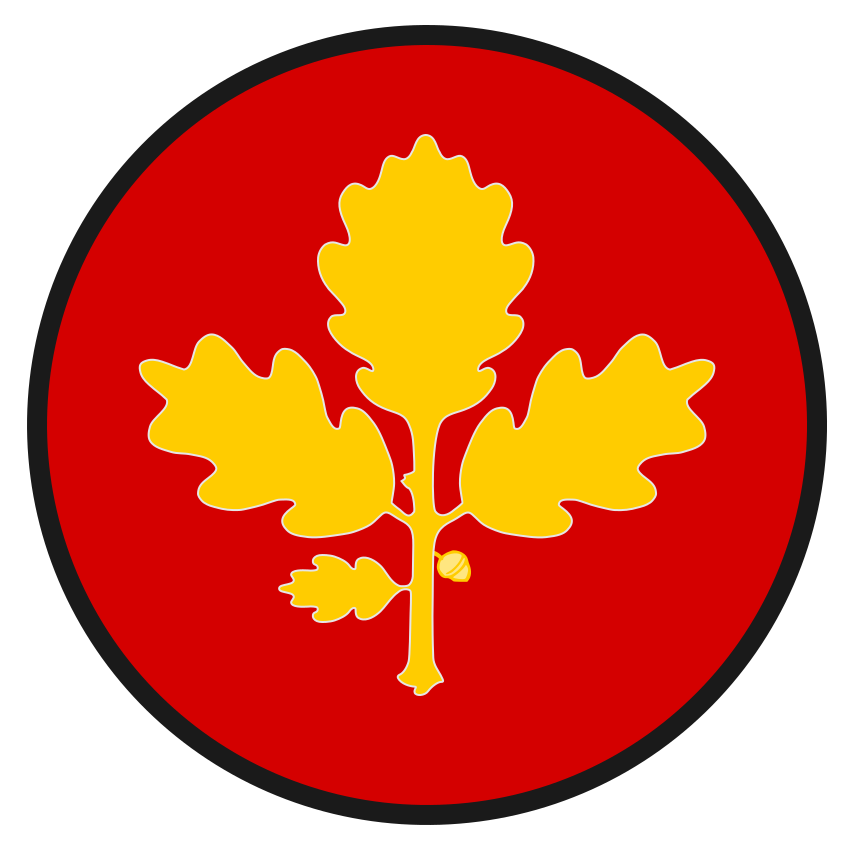
A consensual symbol is the oak sapling (Quercus robur). Although known in other regions, the Eichenbaum, which had long enjoyed a favorable popular image, became typical of German heraldry in the eighteenth century. The branch, Eichenzweig, appeared on the flags of those who wished to defend German liberties by forging unity among the various German states. Thus one saw almost everywhere the deutsche Baum, the weise Vaterbaum or “wise father-tree,” which was also a Gerichtsbaum or “tree of justice,” a guarantor of solidarity and strength. The poet Klopstock (1724–1803) celebrated it. In 1816 the women of Jena presented the students’ association (Burschenschaft) with a flag of three crimson and black bands embroidered with a golden oak branch. The oak branch even became a monetary symbol.
Location
-
Leinefelde-Worbis, Landkreis Eichsfeld, Thuringia, Germany





Add a comment