


Description
One distinguishes the so-called "Insular" Celtic speakers by the use of two dialects: Gaelic and Brittonic. The descendants of the Gaels are the Irish, the Scots, and the Manx; those of the Britons are the Welsh, the Cornish (from Cornwall), and the Bretons.
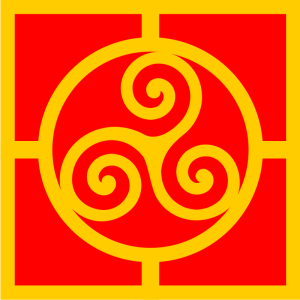
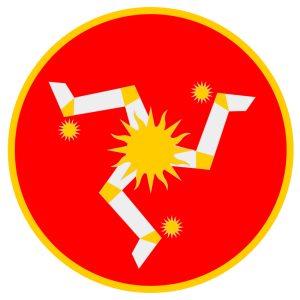
The major signs of the repertoire of Celtic Antiquity (since protohistory) are the double spiral and the triskelion (from the Greek triskelès, adj., “three-footed”; modern Breton triskel from the Greek, triskell via French). The triskelion is interpreted as a metaphor for the sun’s course: morning twilight, zenith, evening twilight (like the triple sign /| ), without excluding related meanings: three units of time, three heavens, three deities (V. Kruta, L’art des Celtes, Paris, 2015; Ph. Jouët, Dictionnaire de la mythologie et de la religion celtiques, Yoran éd., Fouesnant). Archaeological findings (jewelry, coins) clarify the interpretation (frequencies, preferential associations, iconographic context). Another major sign is the four-spoked wheel, a spatio-temporal model, which represents the four regions plus the center in traditional Celtic conceptions.
The triskelion and a variant of the tetraskelion or rotating cross are found in the straw crosses braided in Ireland for the feast of Saint Brigid, as well as in the rope circle bordered by four crosses (an image of the solar year), called the “belt of Brigid,” crios Bríde. Northern European affinities of the feast of Brigid have been noted (S. Ó Catháin, The Festival of Brigit, pp. 15 and 99). The direction of rotation of this “synchronic” sun depends on the position of the observer — to the south or, more commonly in our hemisphere, to the north. (The curved extensions are behind the movement, like fluttering flags, and not, as is often believed, open in front.)
Celtic conceptions favored duality (model of the Divine Twins or “Dioscuric,” seasonal alternation); the ternary (three heavens, three functions); the quaternary formed of three plus one (territories); the quinary (four plus one, the Center; the major gods), as discussed by A. and B. Rees (Celtic Heritage, ch. “Numbers”) and Ph. Jouët, op. cit.
Any “inter-Celtic” emblem consistent with these conceptions must be based on the three and/or the four ordered toward a center.
With regard to all that touches the Celtic world, the distinction between “blue” and “green” — a secondary color distinction — is misleading: the Celtic languages perceive them as a single fundamental color called glas.
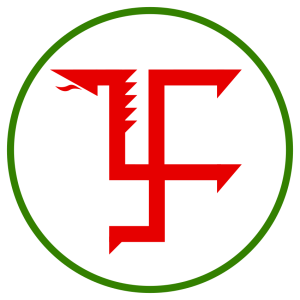
The Brittonic Celts — Welsh, Cornish, and Bretons — have as their common emblem the red dragon (Historia Brittonum, ch. 40–42; ancient Triad Trioedd Ynys Prydein no. 37). There exists a very ancient link between this mythical dragon and the constellation of the same name: King Arthur, sovereign of northern Brittonic lands, has as father Uther Pendragon — that is to say, “Dragon’s Head.” This association refers to the connection between the North Pole indicated by the name Arthur (derived from that of the “bear”) and the neighboring constellation of the Dragon, linked to Ursa Minor. The alpha star of Draco indicated the north celestial pole before being replaced by Polaris. A representation of the Brittonic red dragon based on the constellation Draco may be shared by the Welsh, the Cornish, and the Bretons.
The emblem of the Celtic stock represented here unites triskelion and quadripartition.
Region
Location
-
Arainn





Add a review