

Presentation
Descended from the ancient Krivichians, Radimichians, and Dregovichians, the Belarusian people, or ‘White Ruthenians’ —a name generalized to the entire Republic of Belarus— developed on a territory permeated by Baltic influences. (In Russia, the regions of Smolensk / Smalensk, Sebež, Nevel, and Bryansk still retain certain particularisms of the former White Ruthenia.)
The first administrative language of Grand Lithuania, Belarusian lost its status after the destruction of the Grand Duchy. There came a time when this people spontaneously defined itself as ‘the people from here’, a semantic equivalent of pagani. ‘The first modern formulations of the national idea were closely linked to those of social justice and equity’ (N. Bekus). Through the historical tragedies of the last three centuries, the Belarusian national revival has manifested itself and taken concrete form in various ways, notably since the beginning of the 20th century.
The national emblems derive from the ethnic and historical substratum. A red band, a color taken from the coat of arms, was added (on 25 March 1917) to the white color associated with the White Ruthenians (blue being the preferred color of the Ukrainians). This white–red–white flag, official in 1918, was again official in independent Belarus from 1991 to 1995. Still legitimate, it retains its original meaning.
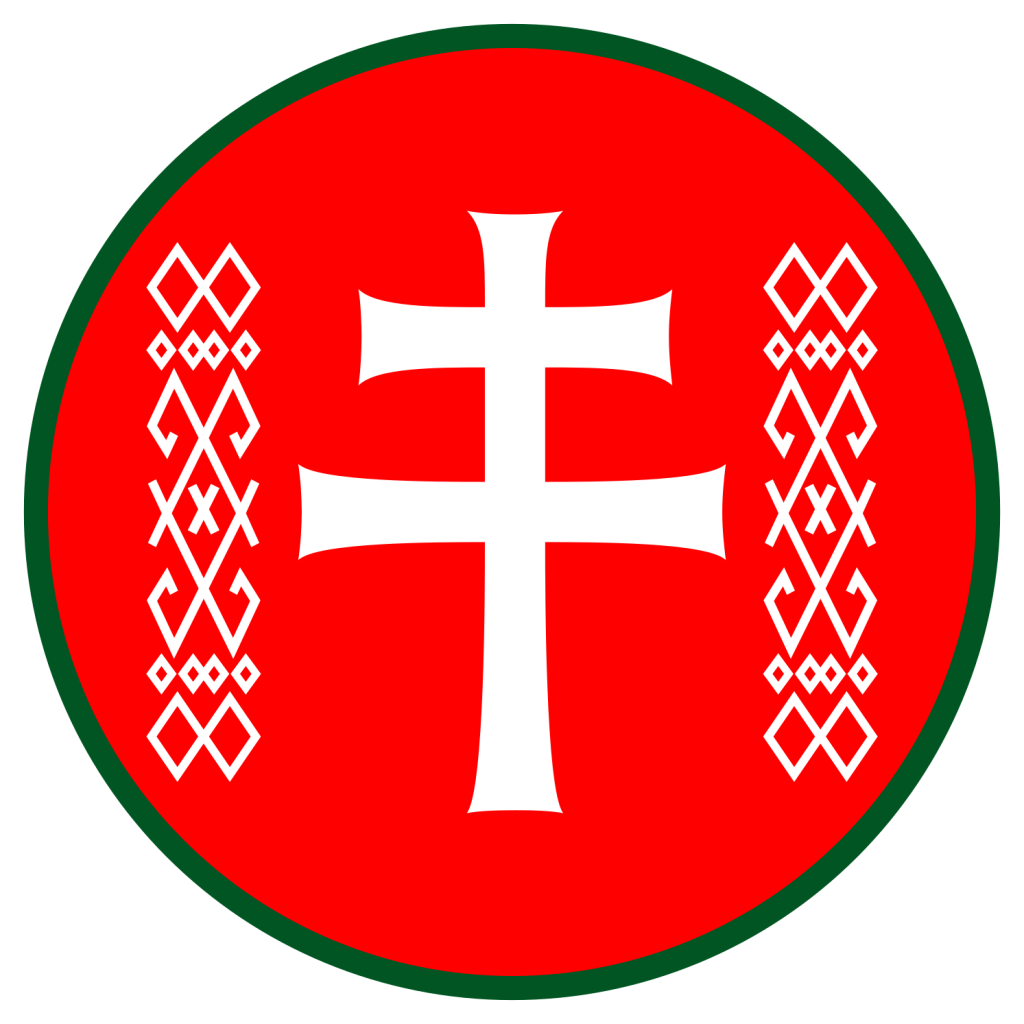
The current state flag displays a white embroidery whose traditional symbolism comes from Belarusian culture. It is read as follows: the rising Sun is represented by a lozenge or rhombus (the angles point to the four directions north, south, east, and west; the sides to the intermediate points and the extreme azimuths of the solstitial risings and settings); wealth and well-being are evoked by the broken lines, horns, and vegetal crooks that extend its sides; the key of Felicity is placed at the center of the lozenge; consecrated loaves form small quadrilaterals.
The ancient art of embroidery experienced vigorous development in Belarus in the 16th and 17th centuries. The lines and designs of embroidery served as a ‘method of understanding the world’ (Vol’ha Labasheuskaia, Повязь часоў: Велaрускі Ручнік, ed. ‘Belarus’, Minsk, 2002, trans. by A. L. Vasil’eva, Link of Times. Belarusian Ruchnik; see also M. S. Katsar, Belaruski arnamient, Tkastva, Vysyuki, Minsk, 1996). The embroideries of belts and sashes, the most renowned of which were those of Slucak (Slutsk), were invested with high social significance, originally magical and religious. Embroidered linen marked the sacred domestic space.
The double-barred cross of the coat of arms is a historical heraldic symbol.
Location
-
Голацкі сельскі Савет, Pukhavichy District, Minsk Region, 222846, Belarus




Add a comment