
Presentation
The flag of the Republic of Ireland, created in the nineteenth century, was made official on January 21, 1919. It brings together the green of the Irish (who bore a golden harp on a green background) and the orange of the House of Orange, with the intention of reconciling the two populations with opposing allegiances. These colors are not simply placed side by side, but are separated by a white band that represents peace, an artifice essential to the legibility of the flag.
The Celtic languages identify the color glas, which encompasses blue, green, and various shades of grey.
To represent the Irish, one may use ogam. This ancient Gaelic notch-writing was developed at the end of Antiquity for linguistic purposes, based on an older signary. The arrangement of the Ogham characters é-r-i-u, which would form the ancient name of the island, is complex, and the first character is not very distinctive when used in isolation.
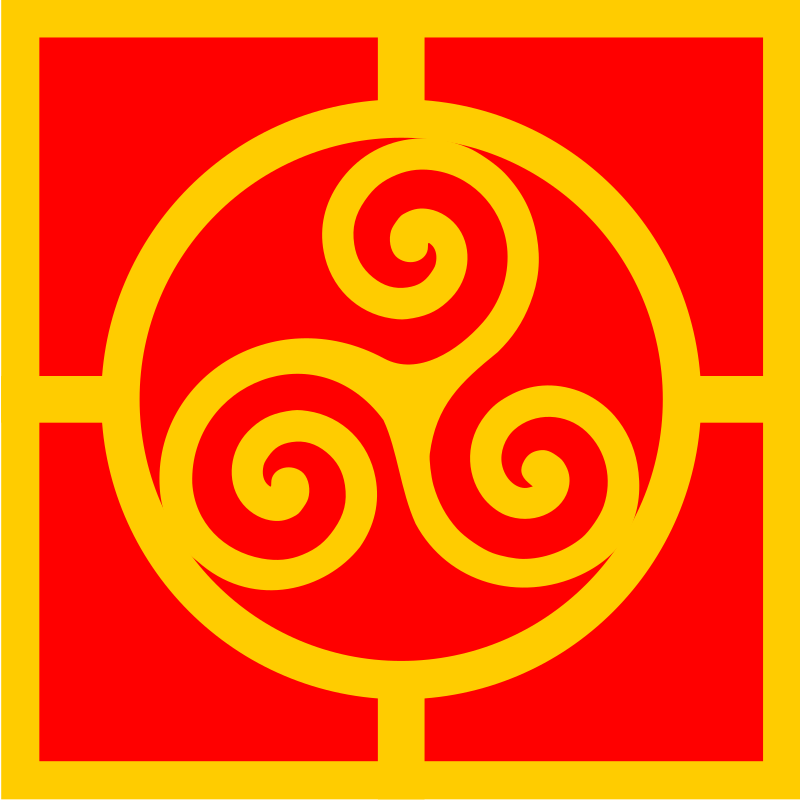
We present here an interlace pattern in keeping with the Gaelic tradition of illumination, sculpture, and embroidery. It indicates the four directions of space and the four traditional provinces of the island — Ulster, Leinster, Munster, Connaught — plus the Center.
The colors are glas and the fiery red of the dawn goddess Brigid (on whom see Ph. Jouët, Dictionnaire de la mythologie et de la religion celtiques).
Region
Location
-
The Municipal District of Athlone — Moate, County Westmeath, Leinster, Ireland