
Presentation
The Austrians are originally a branch of the German people. Their country, the heart of continental Celtic lands and later a Roman province, became for the Germanic peoples who settled there (from the sixth century AD onward) the eastern region (Latin Orientalis pars Bavariae, 9th century; Ostarrîchi, 996; Osterland, Austria, 12th century).
Tyrol, populated from Bavaria in the sixth and seventh centuries, is a very ancient Alpine state, the homeland of Walther von der Vogelweide. It was dismembered in 1918, the southern part being assigned to Italy. The South Tyroleans won institutions of a national character in the province of Bolzano.
Closely related to the Tyroleans, the Mócheni and the Cimbri (Tzimbar, “wood craftsmen”) of the Prealps formed very early (14th century) small republics, Die Dreizehn Gemeinden and Die Sieben Gemeinden/Komàüne or Perghe. German-speaking enclaves persist in Trentino, Friuli, Venezia Giulia, and Piedmont: Fersental / Valle del Fersina / Lusérn / Luserna, Tischlwang / Timau, Sauris / Zahre, Plodn / Sappada, Kanaltal / Valcanale, Zimbern von Kansilien, Remmalju / Rimella, Chalchoufe / Calcoforo, Im Land / Alagna Valsesia, Kampel / Campello Monti, Pumatt / Formazza. The Walser of the Aosta Valley, Oberlystal, and Gressoney extend the domain of the Walser of Switzerland.
The white-and-red banner corresponding to the arms of Austria is attested in 1230. According to legend, it represents the tunic of Duke Leopold V, reddened with blood except where the belt lay, which is said to have served as a rallying sign for the army. It was a military ensign in 1786. The imperial eagle bears on its breast the shield with the arms of Austria.
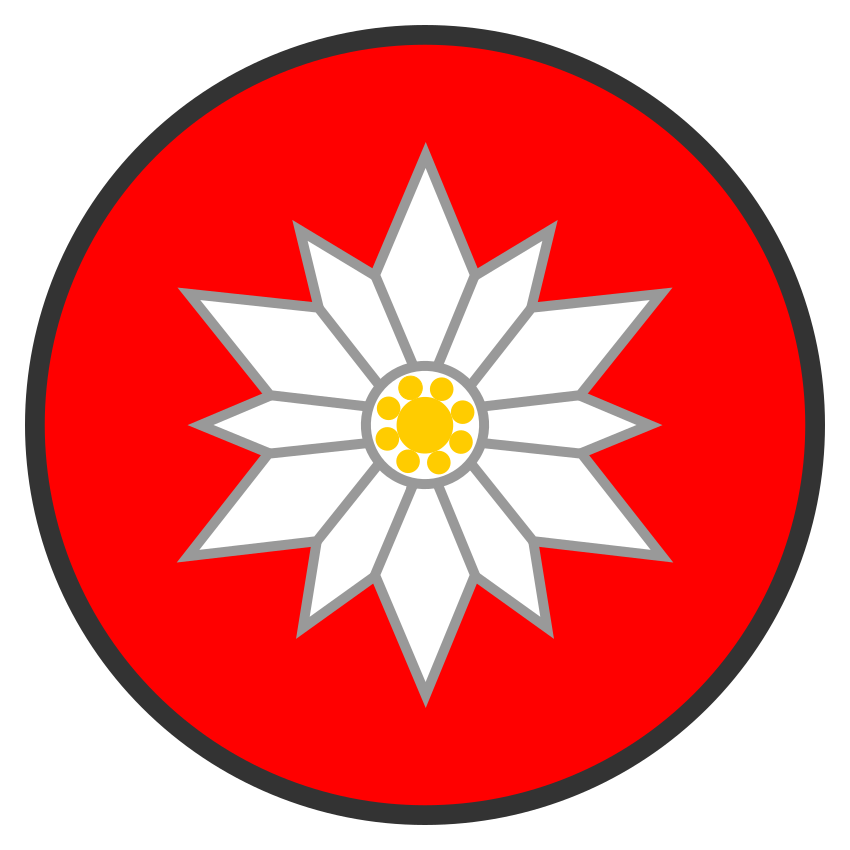
The floral emblem of Austria is the edelweiss, which appears in popular arts and in many official uses (army, coinage, etc.).
Liechtenstein is a princely state of German culture situated between Switzerland and Austria. The flag was officially adopted in 1921. The princely flag uses a horizontal division of gold and red. The crown, added in 1937, is that of a prince of the Holy Empire.
The eagle is a symbol common to these regions. It is that of Austria, Tyrol, and Trentino; it appears on the emblem of the Bernstoler Kulturinstitut / Instituto Mócheno and of the Comunità Bernstoler Gemeinde Trentino; it is also present on the flag of the German-speakers of the Aosta Valley at Alagna. The Silesian eagle of the founding house of Liechtenstein appears on the coat of arms of that country.
We represent the South Alpine Germanic cultural area by the floral symbol of the edelweiss, whose design follows the plan of a star, in keeping with its other designation, Silberstern, “silver star.”
Location
-
Schladming, Politische Expositur Gröbming, Bezirk Liezen, Styria, 8970, Austria




Add a comment