
Presentation
Ukrainians, or Rusyns, Rusini (the Rossï, Roussoi, or Roussinoi of the Greeks, the Rutheni of the Romans), belong to Central Europe and constitute the southern terminus of the Intermarium. The Cimmerians, the Iranian-speaking Scythians and related peoples—including the Sarmatian Iazyges who occupied the Danubian plain—were succeeded by Slavic speakers. Very close to the place of Slavic ethnogenesis, the Ukraïna, or ‘heart of the land’, is also the birthplace of the Rus’ of Kyiv. After the collapse of the Ruthenian state (13th century), the western part—the duchies of Halych and Volodymyr (Lodomeria)—formed a micro Rossia. The assertion of a Ukrainian nationality rests on a long historical experience. A stake for powerful neighbors, aligned either with Roman Uniatism or with Orthodoxy (autocephalous), Ukraine had to overcome severe trials in order to assert itself in the concert of European nations. Part of its distinct character derives from the social and political institutions of the Cossacks of the trans-Dnieper Slobozhanshchyna, whose communities of free men protected their liberties.
Minorities speaking Ukrainian and Ukrainian dialects are found in regions neighboring the Ukrainian state, notably in Poland, Russia (Don, Kuban), Romania, and Slovakia (the Lemkovyna or Lemkivshchyna of the Tatra Mountains). The ‘Carpatho-Ruthenians’ have retained the ancient ethnonym Rusini, associated in particular with medieval Galicia.
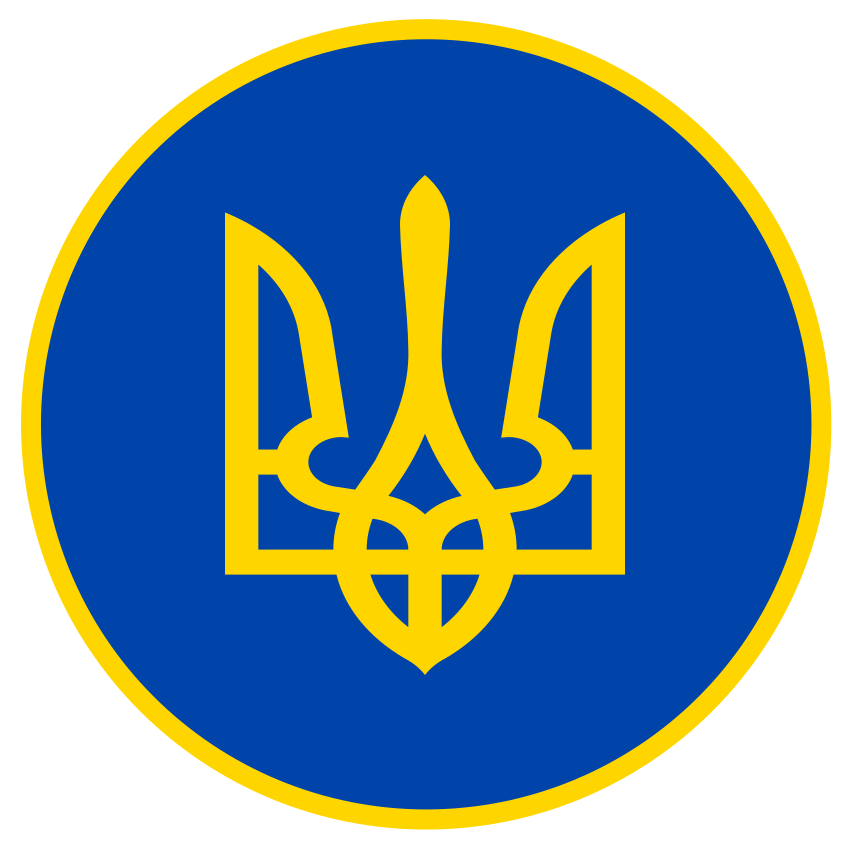
The trident, trižub, is the quintessential Ukrainian symbol.
For possible ancillary ornamentation, see traditional embroidery, višivka (вишивка): O. Grabowicz, Traditional Designs in Ukrainian Textiles, New York, The Ukrainian Museum, 1974; Ukraïnska narodna višivka, Kyiv, 1996; D. Horniatkevič and Lidija Nedadkevič, article ‘Višivka’, Encyclopedia of Ukraine, I, 1984.
Location
-
Kovalivka Rural Hromada, Bila Tserkva Raion, Kyiv Oblast, Ukraine