
Presentation
The land between the Meuse and the Rhine (Lothringen, “land of Lothar,” in the Annales Vedastini, 884) was entrusted in 855 to Lothair II. The Moselle, named after a tributary of the Rhine, has since 1918 formed a distinct French department that brings together the Land of Luxembourg and the Land of the Saar. In these two regions, the Lorrainers—“thiois, tiches”—practice Franconian or Lothringer Platt (Diedenhoven / Thionville), Alemannic, and High German. Metz and the Saulnois share with them certain “Mosellan” particularities and rights (legal and educational). The Moselle, or Moselland, is exposed to acculturation through its tutelary state.
In 1912 the flag of autonomous Alsace-Moselle placed a gold Cross of Lorraine in the canton of the Alsatian flag. More specifically, Mosellan Lorraine at times made use of the heraldic colours of Lorraine in various arrangements. The Luxembourgish flag is not out of place in the Thionville region.
The ᛗ (M) from the Hofzeichen or house marks, surmounted by the Cross of Lorraine, provides another Mosellan emblematic sign.
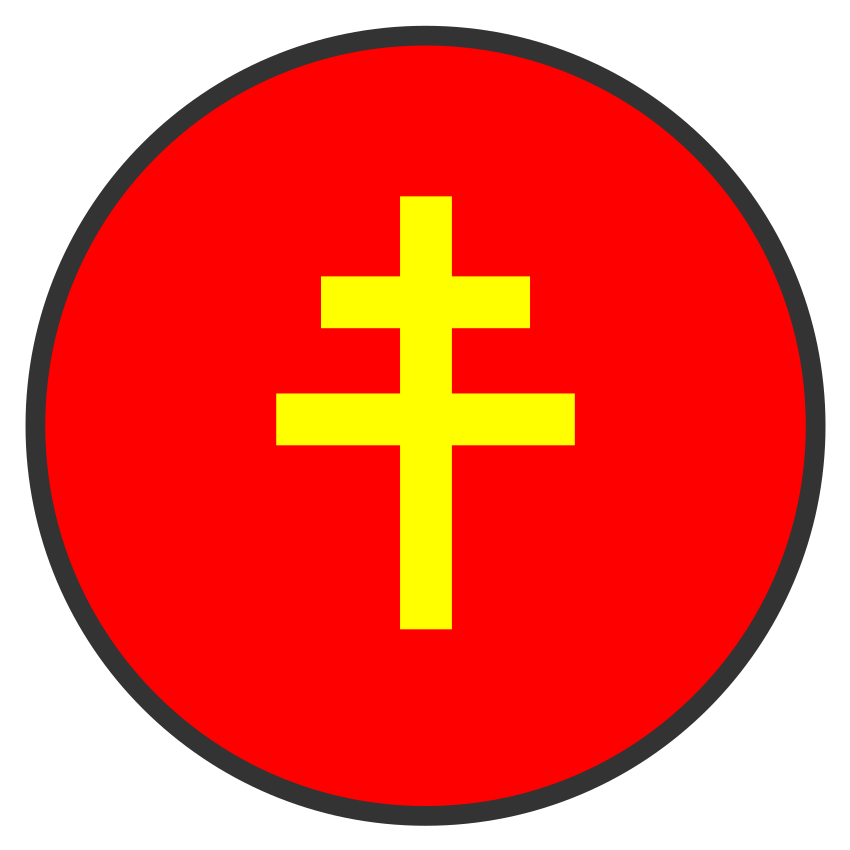
Here we present as an emblem the Cross of Lorraine known as the “Rallying Cross” of 1477. The black of the border comes from the arms of the Pays messin (recorded for the city in 1394).
Location
-
Euvezin, Toul, Meurthe-et-Moselle, Grand Est, Metropolitan France, 54470, France